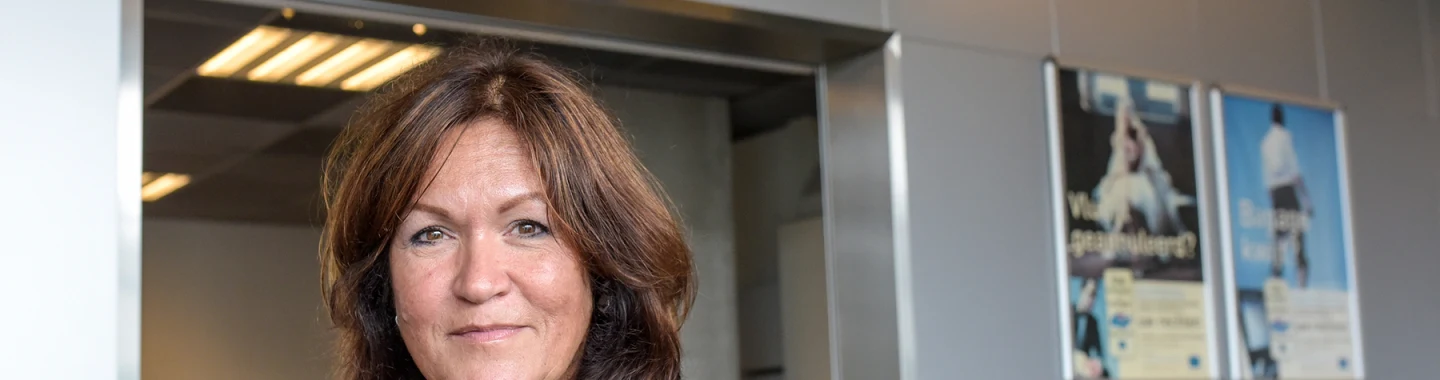
“I'm allowed to look inside every suitcase”
This is the tenth and final story of the '#We are Eindhoven Airport' campaign. Every month we publish a new story on this page featuring an airport staff member, followed a week later by a podcast created by Summa Aviation Services.
Live snails from Morocco, sausages from Bosnia, cheese and citrus fruits from Turkey, ancient statues from Greece and large quantities of cash or cigarettes. Mylène van Roosmalen-Nimberg, Physical Surveillance Officer at Customs at Eindhoven Airport, has seen it all in the eight and a half years she has been working at the airport. “Travellers take stuff with them without always knowing the rules.” But live snails? “Yes, you can take it up to 2 kilos. If they have more in the suitcase, we call in the Dutch Food and Consumer Product Safety Authority for inspection and destruction.” A lot of confiscated food goes to the waste disposal site every week. For example, it is prohibited to import fruit and vegetables from outside the European Union because they can spread diseases. For the same reason, meat can only be imported with a certificate. Travellers carrying cultural goods (e.g. old statues) also need a certificate.
“We inform travellers in every way possible about what they are allowed to take with them, but it's still tempting. It tastes better when it comes from the ‘homeland’, is an explanation we often hear.” Mylène randomly checks arriving and departing passengers. She is also called in by security if a traveller is found carrying a large sum of money and hasn't declared it. If it's ten thousand euros or more, the traveller is legally obliged to report it. If not, it can lead to further investigation and possibly an official report. For the control of large sums of money and narcotics, Mylène's colleagues also regularly work with the specially trained dogs. If the dog sits down next to the traveller, it's bingo. When we proceed to investigation after the check, asking questions is an important tool. “You need to ask about the origin of the goods and, moreover, continue asking the right questions to verify whether the story is true.” A very expensive watch on a person's wrist can raise questions. Then it helps if the wearer has the invoice to prove that the watch hasn't been bought with laundered money, for instance. Sometimes the investigation can be very straightforward. Mylène: “You can often smell the sausages from Bosnia without even opening the suitcase.”
She enjoys her work. “It's diverse and you're always on the floor and in contact with people.” And she wouldn't want it any other way because she is certainly not a desk person. Another plus in her work are the short lines of communication: ‘everyone knows each other here at the airport’ and the team (32 colleagues in all) of young and older colleagues is nice. Mylène: “Every person has a different story. The one I remember most? Probably the traveller who took the urn with his wife's ashes to Spain to scatter them there.”
Listen here to the podcast ‘Ready for Take-Off’ of Summa Aviation Services onSpotify or Apple Podcasts.